
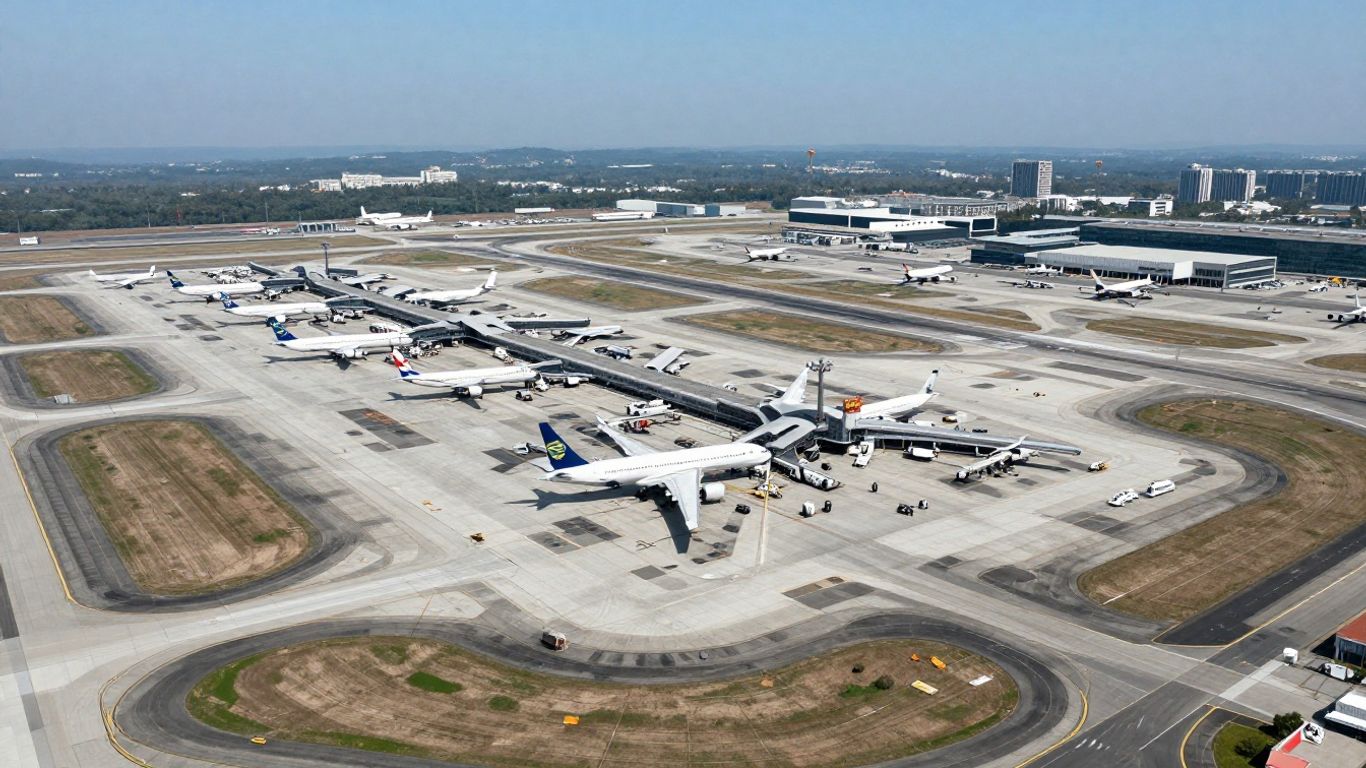
When people ask, ‘what is the largest airport in the United States?’, it’s not always a simple answer. We often think ‘largest’ means the most planes or people, but airports can also be huge in terms of sheer land area. This article breaks down how we can measure airport size, looking at three different ways: how much ground they cover, how many passengers they handle, and how many flights take off and land there. It’s interesting to see how different airports stack up depending on what you’re measuring.
Key Takeaways
- The question ‘what is the largest airport in the United States?’ has different answers depending on whether you mean land size, passenger numbers, or flight operations.
- King Fahd International Airport in Saudi Arabia is the world’s largest by land area, covering almost 300 square miles, far exceeding any US airport.
- Hartsfield-Jackson Atlanta International Airport has historically been the busiest in the US for passenger traffic and aircraft movements, though COVID-19 shifted rankings in 2020.
- Passenger traffic can be split across multiple airports in a metropolitan area; for example, New York City’s combined traffic from its three airports is larger than Atlanta’s single airport.
- Future airports like Beijing Daxing are being built with massive terminals and are projected to become major hubs, potentially changing future rankings.
Defining ‘Largest’ For Airports
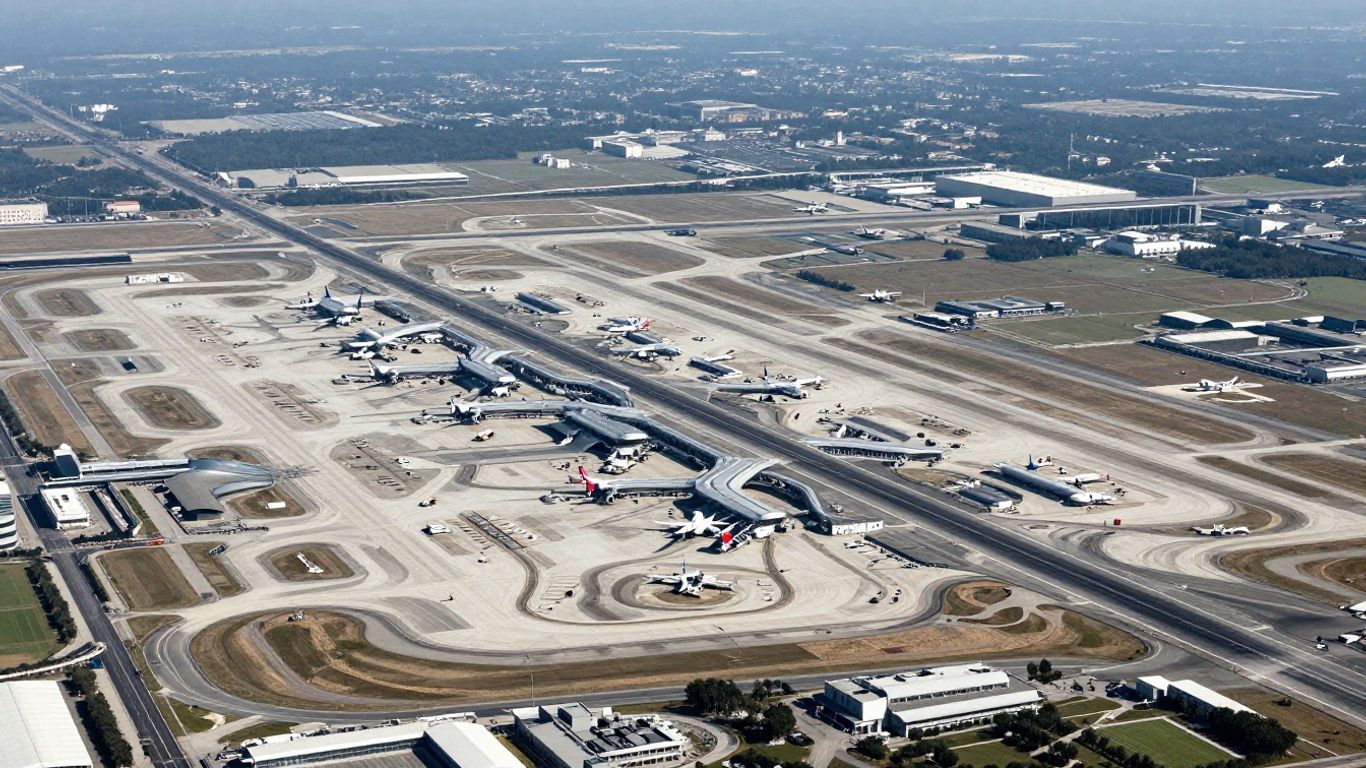
When we talk about the "largest" airport, it’s not as simple as pointing to one place and saying, "That’s it." It really depends on what you’re measuring. Are we talking about how much land the airport takes up, or how many people are actually flying through it? Or maybe it’s about the sheer number of planes taking off and landing? Each way of looking at it gives us a different answer, and understanding these differences is key to really grasping the scale of modern air travel.
Physical Size Versus Passenger Volume
Think about it like this: you could have a massive empty field with a few runways, which would be huge in terms of land area. But if hardly anyone uses it, is it really the "largest" in a practical sense? Probably not. On the flip side, an airport might be packed with terminals and gates, buzzing with activity, but if it’s built on a relatively small piece of land, its physical footprint might not be as impressive.
- Land Area: This measures the total acreage or square miles the airport occupies, including runways, terminals, parking, and any undeveloped land within its boundaries.
- Passenger Volume: This counts the number of people who travel through the airport in a given period, usually a year. It reflects how many travelers are actually using the airport’s services.
- Aircraft Movements: This tracks the total number of take-offs and landings. A high number here means a lot of flight activity, even if passenger numbers aren’t as high (like cargo planes).
The sheer scale of some airports, especially those built in recent decades, is astounding. They are designed not just for current needs but with future growth in mind, often incorporating vast spaces for expansion and new technologies.
The Role of Aircraft Movements
Sometimes, the best way to gauge an airport’s busyness isn’t just by the people passing through, but by the sheer number of planes coming and going. An airport with a high number of aircraft movements might be a major hub for cargo, or it could be a popular spot for smaller private planes, or even a training facility. This metric tells a story about the operational intensity of the airport.
Considering Metropolitan Area Traffic
Another layer to this is looking at the entire metropolitan area. Some cities have one giant, dominant airport. Others, like New York City, split their air traffic across multiple airports. If you only look at one airport in a multi-airport city, you might miss the bigger picture of how much air travel that whole region handles. Combining the numbers from all airports serving a major city can sometimes reveal a much larger overall operation than any single airport might suggest.
Airports By Land Area
When it comes to size, some airports absolutely sprawl across the landscape. But there’s often a big difference between how much ground an airport covers and how many people it actually serves. In this section, we’re focusing only on land area, not on passenger numbers or how busy an airport feels.
King Fahd International Airport’s Vast Expanse
King Fahd International Airport (DMM) in Dammam, Saudi Arabia, holds the crown for largest airport in the world by land area.
- King Fahd covers a shocking 299.61 square miles—almost as much as New York City’s five boroughs combined.
- Besides terminals and runways, it features unique additions such as a mosque and staff residences.
- Despite the space, it serves less than 10 million passengers per year—making it a giant on paper, but far less busy than you might expect.
| Airport Name | Location | Area (mi²) |
|---|---|---|
| King Fahd International (DMM) | Dammam, Saudi Arabia | 299.61 |
It’s wild to think that so much of this airport’s land isn’t even used for terminals or runways. Instead, vast stretches are reserved or simply left undeveloped.
Denver International’s Significant Footprint
Denver International Airport (DEN) stands out as the largest airport in the United States by land area.
- Total area: 53.09 square miles.
- The terminals feel spaced out, which means you may need to hop on a train just to get from one gate to the next.
- Some of DEN’s land is still unused, set aside for possible future expansion or development.
Here’s how a few of the largest US airports stack up by land area:
| Airport Name | Location | Area (mi²) |
|---|---|---|
| Denver International (DEN) | Denver, CO | 53.09 |
| Dallas/Fort Worth (DFW) | Dallas, TX | 26.88 |
| Orlando International (MCO) | Orlando, FL | 20.78 |
| Washington Dulles (IAD) | Washington, DC | 18.75 |
Comparing Airport Size to City Areas
Sometimes, seeing these numbers just makes you shake your head. When you compare major airports to cities, their sheer size gets even more striking.
- King Fahd International is just a few square miles smaller than all of New York City (302.6 mi²).
- Denver International swallows up more land than the entire city limits of, say, San Francisco.
- Many airports clear enough ground to fit several smaller towns inside their fences—and most people passing through never notice more than a fraction of it.
The thing is, when you’re sitting at your gate, you almost never realize how much space is really out there beyond the terminal windows. Behind the scenes, these airports keep room for cargo, runways, service roads, and sometimes just empty fields—waiting for whatever the future might bring.
Airports By Passenger Traffic
When people talk about the ‘biggest’ airport, they often mean the one with the most people flying through it. This is usually measured by the number of passengers who pass through the airport in a given year. It’s a pretty straightforward way to see which airports are the busiest hubs for travelers.
Hartsfield-Jackson Atlanta International Airport’s Historical Dominance
For a long time, Hartsfield-Jackson Atlanta International Airport (ATL) was the undisputed champion when it came to passenger numbers. It held the top spot for over two decades, which is a really impressive run. Its location is a big reason why. Atlanta is pretty central in the US, making it a convenient stop for a lot of flights. Plus, it’s a major spot for business and tourism, drawing in tons of people.
The Impact of COVID-19 on Passenger Rankings
Then, well, 2020 happened. The COVID-19 pandemic really shook things up for air travel. International flights were restricted, and people just weren’t traveling as much. This caused a huge drop in passenger numbers at almost every airport. Some airports, like Guangzhou Baiyun International Airport in China, saw smaller drops and ended up taking the top spot for that year. Atlanta’s airport, while still incredibly busy, saw a big dip, falling from its usual number one spot.
Here’s a look at how some major US airports stacked up in terms of passenger traffic in 2020:
| Rank | Airport Name | Location | Passengers |
|---|---|---|---|
| 1 | Guangzhou Baiyun International | Guangzhou, China | 43,767,558 |
| 2 | Hartsfield-Jackson Atlanta Intl. | Atlanta, GA | 42,918,685 |
| 4 | Dallas/Fort Worth International | Dallas, TX | 39,364,990 |
| 8 | Denver International | Denver, CO | 33,741,129 |
Comparing Individual Airports to Metropolitan Totals
It’s also interesting to think about how passenger traffic is counted. Sometimes, a city might have multiple airports. For example, New York City has JFK, LaGuardia, and Newark Liberty. If you look at each of those airports individually, they might not seem as busy as a single, massive airport in another city. But if you add up all the passengers going through all of New York’s airports, the total is actually huge – even bigger than Atlanta’s. This shows that sometimes, looking at the whole metropolitan area gives a different picture than just looking at one airport’s numbers.
When we talk about the busiest airports, it’s easy to get caught up in the numbers for a single location. However, for large metropolitan areas with multiple airports, combining the passenger traffic across all of them often reveals a much larger overall picture of air travel activity for that region.
So, while Hartsfield-Jackson Atlanta International Airport has a long history of being the busiest, the definition of ‘largest’ can change depending on whether you’re looking at a single airport’s performance or the total air traffic for an entire city region, especially in the wake of global events like the pandemic.
Airports By Aircraft Movements
When we talk about airport size, we often think about how much space it takes up or how many people pass through it. But there’s another way to measure an airport’s ‘busiest’ status: the sheer number of take-offs and landings. This metric, known as aircraft movements, gives us a different perspective on which airports are truly the most active.
Hartsfield-Jackson Leads in Take-Offs and Landings
For a long time, Hartsfield-Jackson Atlanta International Airport (ATL) has been a powerhouse when it comes to aircraft movements. It consistently handles a massive volume of flights, making it a hub of constant activity. Even with the disruptions of recent years, ATL often finds itself at or near the top of this list. It’s a testament to its strategic location and its role as a major connection point for travelers across the country.
O’Hare and Dallas/Fort Worth Follow Closely
It’s not just Atlanta that’s buzzing with activity. Airports like Chicago O’Hare International (ORD) and Dallas/Fort Worth International (DFW) are also incredibly busy. These airports are vital gateways for their respective regions and handle a huge number of flights daily. They often compete for the top spots, showing just how much air traffic they manage.
Here’s a look at how some of the busiest US airports stacked up in terms of aircraft operations in a recent year:
| Rank | Airport Name | Code | Location |
|---|---|---|---|
| 1 | Hartsfield-Jackson Atlanta Intl. | ATL | Atlanta, GA |
| 2 | O’Hare International Airport | ORD | Chicago, IL |
| 3 | Dallas/Fort Worth International | DFW | Dallas, TX |
| 4 | Denver International Airport | DEN | Denver, CO |
| 5 | Phoenix Deer Valley | DVP | Phoenix, AZ |
Comparing 2020 Movements to Pre-Pandemic Levels
The year 2020 was, to put it mildly, unusual for air travel. The global pandemic significantly impacted flight schedules worldwide. Many airports saw a sharp drop in operations compared to previous years. For instance, while ATL and ORD handled around 2,500 movements per day in 2019, that number decreased considerably in 2020. This shift highlights how external events can dramatically alter airport activity, even for the busiest ones. It’s interesting to see how these numbers bounced back, and which airports recovered fastest. The passenger traffic data from 2021 shows a strong recovery for many of these same airports.
The number of take-offs and landings at an airport is a direct measure of its operational intensity. It reflects not just passenger volume but also cargo flights, general aviation, and the overall logistical demands placed on the airport’s infrastructure and air traffic control.
It’s clear that measuring airport size by aircraft movements gives us a very different picture than just looking at land area or passenger numbers. These numbers show the constant, high-paced rhythm of airports that serve as critical nodes in our transportation network.
Future Projections and Emerging Giants
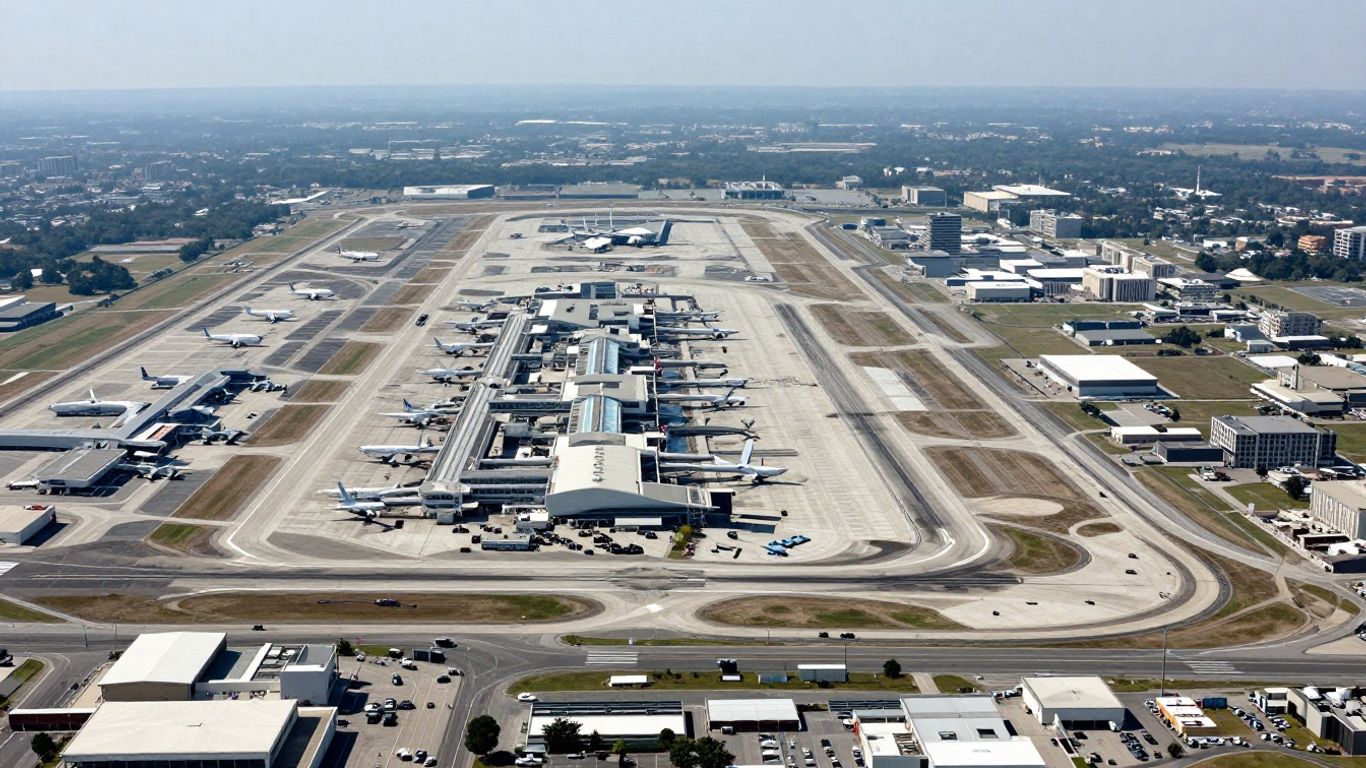
As air travel shifts and new airports open their doors, the landscape of the world’s busiest hubs is starting to change. Emerging airports with bold designs and ambitious growth targets are competing to become the biggest players in the coming decades. The criteria for "largest" keep evolving, not just based on how many passengers move through the gates, but how efficiently and quickly they can get to those gates or even how airports connect entire metropolitan regions.
Beijing Daxing’s Ambitious Design
- The Beijing Daxing International Airport stands out for its size and futuristic layout.
- The terminal covers roughly 7.5 million square feet—about 130 American football fields lined up.
- Its starfish configuration isn’t just for show—it was laid out to get people from the central check-in area to any gate in under eight minutes.
- Daxing’s ability to ramp up quickly already puts it on forecasts to become the world’s busiest by 2040.
| Feature | Value |
|---|---|
| Terminal Size | 7.5 million sq ft |
| Projected Rank | #1 for passenger volume (2040) |
| Design | Starfish-shaped, rapid access |
Airports like Beijing Daxing are changing the game by focusing on both efficiency and mind-blowing size, making airport travel a lot less stressful for everyone.
Anticipating Future Busiest Airports
The top airports today may not hold onto their titles forever. These are a few trends on the horizon:
- New airports in regions with growing populations, especially in Asia and Africa, may soon rival the busiest in the US.
- Changes in air traffic patterns, low-cost carriers, and international travel can quickly boost or drop an airport’s ranking.
- Infrastructure upgrades at older airports may help them stay relevant, but new constructions often leap ahead with more efficient layouts and tech.
In the Americas, San Francisco International is already making waves, claiming a top spot for 2026’s top 50 airports and showing that established airports can still keep up. It’ll be interesting to watch if these traditional giants can maintain their share as newer airports rise and travel rebounds and grows in different corners of the world.
So, What’s the Verdict?
Alright, so we’ve looked at airports from a few different angles, right? It turns out ‘largest’ isn’t a simple answer. You’ve got these massive places like King Fahd International in Saudi Arabia that cover more ground than you can imagine, but don’t see a ton of people. Then there’s Atlanta’s Hartsfield-Jackson, which used to be the king of passenger numbers for ages, and still handles a ton of flights. And let’s not forget about places like New York City, where if you add up all their airports, they move way more people than any single airport. It really just depends on what you mean by ‘largest’ – are we talking land, people, or planes? It’s a good reminder that sometimes the obvious answer isn’t the whole story.
Frequently Asked Questions
What does ‘largest airport’ mean?
When we talk about the ‘largest’ airport, it can mean a few different things! It could be about how much land the airport covers, or how many people use it each year, or even how many planes take off and land there. Each way of measuring gives us a different answer.
Which airport is the biggest in the world by land size?
The airport that covers the most land is King Fahd International Airport in Saudi Arabia. It’s huge, almost as big as all five parts of New York City put together!
Which airport handles the most passengers?
Usually, Hartsfield-Jackson Atlanta International Airport is the busiest with the most passengers. However, sometimes other airports, like Guangzhou Baiyun in China, can take the top spot, especially when travel is affected by events like the COVID-19 pandemic.
Why isn’t New York City’s airport traffic combined to make it the busiest?
New York City has three major airports. While each one individually might not be the busiest, if you add up all the passengers from all three, the total is actually higher than the busiest single airport. It’s like splitting a big pie into three slices – each slice is smaller, but together they make a big pie.
What are ‘aircraft movements’?
Aircraft movements simply mean the total number of take-offs and landings at an airport. It’s a way to measure how busy an airport is based on the number of flights, not just the number of people.
Are there airports that are expected to become busier in the future?
Yes! For example, Beijing Daxing Airport in China has a massive new terminal and is designed to handle a lot of people very quickly. It’s expected to become one of the busiest airports in the world in the coming years.